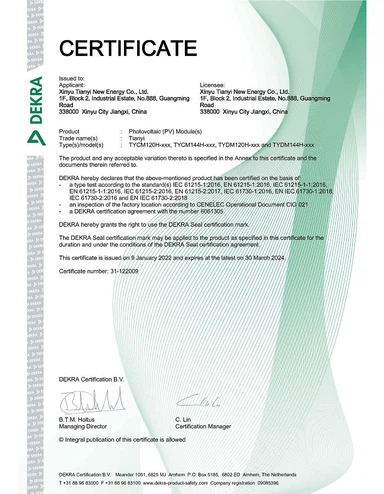
হাফ সেল সোলার প্যানেল


A half-cell solar panel is a type of solar module that uses half-cut solar cells. Half-cut solar cells are conventional photovoltaic cells that are cut in half, which helps in reducing the electrical losses and improving the panel's performance. Half-cut design reduces the current passing through individual cells, improving the overall efficiency of the panel. By increasing the number of busbars (metal strips that conduct the electrical current) on both sides of each solar cell, the total current path is increased, minimizing electrical losses and increasing the module's efficiency.


Half-cell solar panels perform better at high temperatures compared to conventional solar panels, which allow them to produce more energy in warmer areas.


Half-cell solar panels have a better shade tolerance compared to conventional solar panels. The panel's individual cells are connected separately, and if any cell gets shaded, the others can still produce energy.


Half-cell solar panels are more durable than conventional solar panels due to their design and the use of advanced materials, which includes tempered glass, aluminum frames, and corrosion-resistant materials.


Half-cell solar panels have a longer lifespan than conventional solar panels. They are built to withstand harsh weather conditions, including high wind speeds, heavy snow, and extreme heat, which ensures that they last for a long time.


Half-cell solar panels generate more power than conventional solar panels. They are ideal for large commercial and residential applications, which require high power output.


Lifepo4 Battery Solar System

Half cell solar panels are commonly used to power small electronic devices such as calculators, keyboards, and other low-power devices.

Power Supply Battery

Deep Cycle Lifepo4 Battery Cell

Off-Grid Power Supply

Half cell solar panels are used to generate power for off-grid applications such as remote cabins, campsites, and other locations where grid power is not available.

EV LiFePO4 Battery

Street lighting systems powered by half cell solar panels are becoming increasingly popular in many cities around the world as they provide a sustainable and cost-effective solution for lighting.

Rechargeable Lithium Ion Battery

Solar Storage System Battery


These panels use single-crystal silicon cells that are sliced into thinner wafers to reduce the amount of material needed for each cell. This increases the efficiency of the panel because the smaller cells are less prone to shading and can generate more power from the same amount of sunlight.


Half-cut solar cell modules are not a technology developed with new and innovative chemical components added to the cell. Actually, the half-cut solar cell technology is based on the traditional crystalline silicon (c-Si) solar cells.


10KWH Solar Power Wall Home Lithium Battery


The first step in fabricating half-cell solar panels is cutting the solar cells into halves or thirds.

Next, the half-cells are mounted onto a substrate with clear adhesive to form a full-sized solar panel.

Once the wiring is complete, the solar panel is encapsulated to protect it from harsh environmental elements. Encapsulation involves adding a layer of ethylene-vinyl acetate (EVA) between the cells and a glass layer, which are sandwiched between two layers of polymer backsheet.

Finally, the half-cell solar panel undergoes rigorous testing to ensure that it meets the stringent quality standards set by the industry. The testing involves checking the performance parameters such as maximum power output, current, and voltage, and ensuring that there are no defects or damage to the components. 


280AH Lifepo4 Battery
100AH Lithium Battery Cell
Power Supply Battery
Lifepo4 Battery Solar System


MECC has become a world well-known brand,successfully developed and manufactured powerwall ,Li-Ion Battery Pack ,solar energy system Residential Energy Storage System .Since then, MECC's products have supported renewable energy enthusiasts and production facilities around the world, now covering more than 140 countries, establishing itself as an unshakable leader in the solar energy systems industry.

productcate-500-500
productcate-500-500


productcate-1-1
productcate-1-1
productcate-1-1
productcate-1-1
productcate-1-1
productcate-1-1


Q: Are half-cell solar panels better?

A: What are the advantages of half-cut cells? The advantages of half-cut cell panels are numerous. They improve the power output and performance of solar modules because they offer a higher shade tolerance due to their unique wiring system.

A: Split cell/half-cut technology is pretty simple – cut each cell in half. So, instead of having 60 square cells, you have 120 rectangular ones. The panel stays almost identical in terms of size and weight. REC was the first company to release split cell/half-cut panels, in 2014, but now it's standard with most panels.

Q: What is the difference between half-cells and full cells?

A: A half-cell is a single electrode in an electrochemical cell, while a full cell is a complete electrochemical cell that consists of two half-cells connected by a salt bridge.

Q: How efficient are half-cell solar panels?

A: The main benefits of the half-cell panels for users are a 2-3% higher module output and higher total yields. In a half-cell module, standard full cells are cut into two equal halves. In addition, the panel is also divided into an upper and a lower half and the half-cells arranged thereon.

A: Half-cut solar cell technology boosts the energy production of solar panels by lowering cell size, allowing more cells to fit on the panel. The panel is then divided in half so that the top runs independently of the bottom, generating more energy even if one part is shaded.

Q: What are the 3 types of solar panels?

A: In this blog, we will explore the main three types of solar panel cells: polycrystalline, monocrystalline and thin-film. Understanding the difference between the three is the very first step to selecting the perfect panel for your home, business or community.

A: They offer reduced power loss, higher efficiency, improved reliability, and better shading tolerance. While the upfront cost of half-cut cells may be higher than traditional solar panels, the long-term benefits of increased efficiency and reliability make them a worthwhile investment for any PV installation.

Q: What is the purpose of a half-cell?

A: A half cell is one of the two electrodes in a galvanic cell or simple battery. For example, in the Zn−Cu battery, the two half cells make an oxidizing-reducing couple. Placing a piece of reactant in an electrolyte solution makes a half cell.

A: Monocrystalline solar panels offer better efficiency because they're produced from pure silicon. They have a sleek, black color and produce more power per square foot but are more expensive. Polycrystalline solar panels use multi-crystalline silicon, which results in lower efficiency.

A: Solar cells in a panel are typically wired in series. This means that the volts of each solar cell add up to create the total voltage output. Thus, the voltage of a 72-cell panel is higher and will output more watts than a 60-cell solar panel.

Q: Why are solar panels only 20 efficient?

A: Solar cells can never reach 100% efficiency because the solar spectrum puts out photons with a broad range of energies. Some of those photons will have higher energy than the band gap of the semiconductor used in the solar cell and will be absorbed creating an electron-hole pair.

A: The traditional solar panels such as monocrystalline or Mono PERC solar panels have 60 to 72 solar cells. However, in the case of Half-cut solar panels, the solar cells are cut into two halves, resulting in the increased number of cells from 120 to 144.

A: Mono PERC half cut cells type Panel. Capacity – 540 Watt, 24V. Voltage: Voltage at Max Power (Vmax) – 41.92V, Open Circuit Voltage (Voc) – 49.40V.

A: How many solar panels are needed to power a house? The average U.S. household needs between 15 and 20 solar panels on its roof to generate enough electricity, or around a 9 kW system. That being said, the number of panels needed depends on the amount of power a household uses.

Q: Why do half-cells need to be neutral?

A: If no salt bridge were present, the solution in one-half cell would accumulate a negative charge and the solution in the other half cell would accumulate a positive charge as the reaction proceeded, quickly preventing further reaction, and hence the production of electricity.

Q: What is the connection between two half-cells?

A: The two half-cells are set up in different containers, being connected through the salt bridge or porous partition. Both the electrodes are placed in a same container in the solution of molten electrolyte.

Q: Why two half-cells are used in galvanic cell?

Q: What does a half-cell contain?

A: You'll need more polycrystalline panels to match the power output of monocrystalline options. Polycrystalline panels also have a shorter life span. According to the American Solar Energy Society, monocrystalline panels can last up to 40 years, while polycrystalline options last for 35.

We're well-known as one of the leading half cell solar panel manufacturers and suppliers in China. If you're going to wholesale custom made half cell solar panel with competitive price, welcome to get more information from our factory.

থলে